
Telecom price monitoring
Monitor subscriptions, device prices and promotions
Do you know how quickly telecom prices really change?
The telecom market is one of the most dynamic pricing markets in the Netherlands.
Providers and telecom sellers adjust their subscription rates, device prices, data allowances, discounts and promotions almost every day. New offers launch, temporary cashback campaigns appear and existing deals disappear again.
Telecom price monitoring extends beyond mobile subscriptions and device prices. Internet and fibre broadband offers can also be monitored. Rates, welcome discounts and other commercial promotions may differ by provider, product and region.
For providers, telecom retailers, comparison platforms and commercial teams, maintaining a current view of telecom offers’ price positions manually is therefore becoming increasingly difficult.
A telecom price also consists of much more than a monthly fee. Factors such as contract duration, data allowance, internet speed, device choice, activation fees, one-off discounts, cashback and temporary promotions jointly determine the final price.
Scrape IT automates telecom price monitoring by continuously collecting, validating and historically storing pricing information from public telecom websites.
Where relevant, pricing information can also be collected at postcode or regional level. This makes differences in rates, discounts and commercial offers between areas visible without checking every location manually.
This gives your organisation current and historical telecom pricing data to track price developments, compare offers objectively and base pricing decisions on facts instead of assumptions.
Why telecom price monitoring is becoming increasingly important
A telecom subscription is much more complex than the price of a standard product.
The final monthly fee is influenced by dozens of pricing components that change continuously. Providers launch temporary offers, increase data allowances, change device discounts or adjust contract terms. As a result, an offer may appear unchanged on paper even though its total value to the consumer has shifted considerably.
Looking only at the monthly fee means missing a large part of the pricing strategy.
Tracking telecom prices over longer periods helps answer questions such as:
- Which providers make structural price changes?
- Which subscriptions regularly feature in promotional campaigns?
- Which device combinations are temporarily priced more aggressively?
- Which cashback offers recur regularly?
- Which pricing components change most often?
- Which price changes genuinely require a commercial response?
These insights help pricing, proposition and commercial teams make better-informed pricing decisions.
Expert insight
In telecom, the greatest challenge is usually not collecting prices but comparing offers fairly.
A subscription consists of several pricing components that jointly determine its commercial value. Comparing monthly fees alone can quickly produce a distorted view of the market.
Tracking every relevant pricing component historically reveals the strategy behind an offer rather than just today’s price.
Common telecom pricing challenges
Subscriptions are difficult to compare objectively
Telecom offers differ in many more ways than just the monthly fee.
Data allowances, contract duration, devices, activation fees, one-off discounts, cashback offers and additional services jointly determine a subscription’s total value.
Comparing only one component does not produce a fair price comparison.
Price changes are discovered too late
Providers continuously adjust their commercial propositions.
New offers appear, existing deals are amended and promotions expire.
When these changes are checked only manually, important price movements are often discovered after they have already affected the competitive position.
Historical price developments are missing
A current offer shows only what the market looks like today.
Strategic pricing decisions require insight into how telecom prices develop over longer periods. This includes:
- historical price developments
- promotional patterns
- cashback campaigns
- changes in data allowances
- device price developments
- changes in monthly rates
- recurring discount offers
Without historical data, it remains difficult to assess providers’ pricing strategies accurately.
The same offer changes continuously
Telecom offers are regularly adjusted without an entirely new subscription being introduced.
For example:
- a larger data allowance
- a lower device price
- an extra discount during the first months
- a different contract duration
- a new cashback offer
- adjusted activation fees
Consequently, an offer’s commercial value changes continuously while appearing almost identical to consumers at first glance.
Manual monitoring takes too much time
Many organisations check several telecom websites every day to keep track of prices and promotions.
Once multiple providers, subscription types and device combinations need to be followed, this process becomes labour-intensive and prone to errors.
Automated telecom price monitoring keeps pricing information continuously updated without manual checks.
Continuous telecom price monitoring at scale
Effective telecom price monitoring involves much more than collecting monthly fees.
Pricing information must be:
- validated
- linked to the correct subscriptions
- stored historically
- checked for price changes
- enriched with relevant pricing components
- made available to dashboards, reports and existing systems
Scrape IT collects pricing information from public telecom websites and converts it into reliable datasets, dashboards, alerts and API integrations.
Depending on the provider and required frequency, price changes can be processed daily or several times a day.
Telecom price monitoring can be used for:
- price comparisons
- monitoring SIM-only subscriptions
- monitoring mobile subscriptions
- device price monitoring
- promotion monitoring
- cashback monitoring
- historical price analysis
- price alerts
- proposition management
- pricing dashboards
- AI and analytics applications
What do we monitor?
SIM-only subscriptions
SIM-only subscriptions change continuously.
Providers adjust monthly fees, increase data allowances, introduce temporary discounts or change contract durations. This means a subscription’s total value can change regularly without being immediately apparent.
Scrape IT monitors:
- monthly fees
- data allowances
- call and text allowances
- contract duration
- introductory discounts
- temporary offers
- cashback offers
- activation fees
- price changes over time
This reveals how providers develop their SIM-only propositions and which price changes genuinely affect the competitive position.
Mobile subscriptions with a device
Subscriptions that include a device consist of several pricing components.
Alongside the monthly fee, the device price, term, one-off payments, device discounts and promotions all play an important role.
We monitor:
- monthly subscription fees
- device prices
- one-off device payments
- contract duration
- data allowances
- promotions
- cashback offers
- activation fees
- total cost over the contract period
This enables objective comparisons between subscriptions, even when providers use different pricing structures.
Standalone device prices
Standalone device prices also change continuously.
New models are launched, existing devices decrease in price and retailers regularly start temporary promotions.
Scrape IT monitors:
- current selling prices
- price changes
- recommended retail prices
- promotional prices
- availability as additional pricing context
- historical price developments
This provides insight into device price developments throughout the full product lifecycle.
Promotions and cashback offers
Temporary promotions drive a large part of the competition within telecom.
Providers compete not only with lower monthly fees but also with cashback campaigns, free additional data, device discounts and temporary introductory offers.
We monitor:
- cashback offers
- introductory discounts
- temporary price reductions
- free months
- bundle promotions
- seasonal campaigns
- Black Friday offers
- other commercial promotions
This reveals which promotions are used, how long they last and which campaigns recur regularly.
Historical price developments
A current telecom price tells only part of the story.
We therefore store pricing information historically to reveal:
- how monthly fees develop
- how device prices change
- which promotions recur regularly
- which providers make structural price changes
- how long offers remain active
- which pricing components change most frequently
This provides insight into pricing strategies rather than individual price measurements.
Price comparisons between providers
Telecom prices can only be compared properly when every relevant pricing component is included.
Subscriptions can therefore be compared using:
- provider
- data allowance
- contract duration
- device
- monthly fee
- total contract value
- promotions
- cashback
- additional pricing components
This produces objective price comparisons between comparable subscriptions.
Automated price alerts
There is no longer any need to check telecom websites manually.
Scrape IT can send automatic notifications when, for example:
- a provider changes its price
- a cashback offer starts
- a promotion expires
- a device price changes
- a data allowance is adjusted
- a competitor introduces a new price
- a set price threshold is exceeded
This makes price changes immediately visible without daily checks.
From individual telecom prices to a central pricing dashboard
Telecom pricing information only delivers real value when it is made available in a clear and accessible way.
Scrape IT can make all collected pricing information available in a single dashboard where users can:
- compare providers
- filter subscriptions
- analyse price developments
- view historical price charts
- track promotions
- analyse cashback campaigns
- manage watchlists
- configure price alerts
- export reports
This creates one central environment in which pricing, proposition and commercial teams can identify price developments requiring attention more quickly.
Telecom price monitoring dashboard
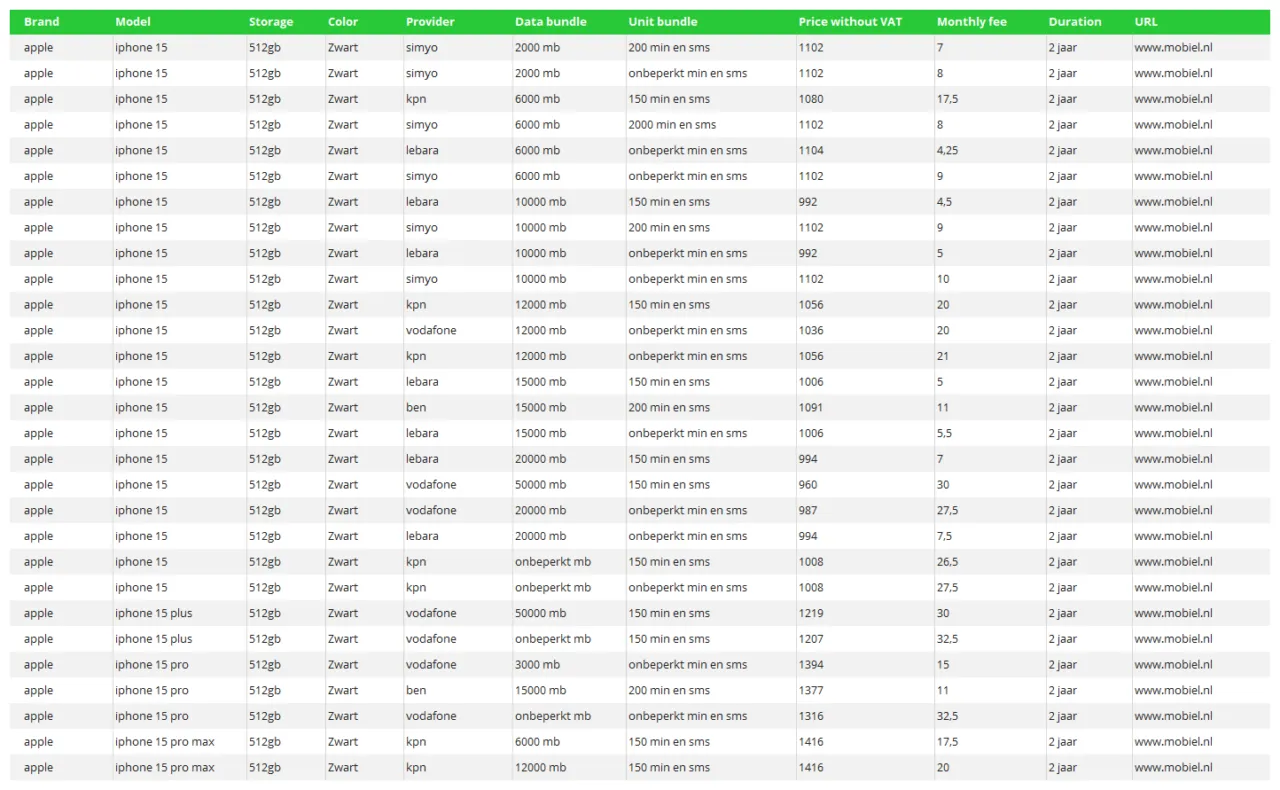
Gain real-time insight into subscriptions, device prices, data allowances, promotions, cashback offers and historical price developments. Compare providers, analyse pricing strategies and receive automatic notifications about relevant price changes.
Practical example: from individual offers to objective price comparisons
At first glance, telecom offers often appear easy to compare.
In practice, subscriptions consist of dozens of pricing components that jointly determine their commercial value.
A lower monthly fee does not automatically mean an offer is cheaper. Additional data, cashback, device discounts or a different contract duration can make a substantial difference.
Scrape IT therefore collects more than current prices: it brings every relevant pricing component together in a single dataset.
This reveals:
- which providers adjust their prices
- which promotions are temporary or structural
- which cashback offers recur regularly
- how device prices develop
- which subscriptions are genuinely comparable
- which price changes affect market position
The question therefore changes from:
What does this subscription cost today?
to:
Which pricing strategy is this provider using, and when does a price change require action?
This distinction is precisely what makes telecom price monitoring a strategic tool for pricing, proposition and commercial teams.
What does telecom price monitoring deliver?
Automatically collecting and continuously updating telecom prices creates a more reliable foundation for pricing decisions.
Organisations use telecom price monitoring for:
- price comparisons
- proposition management
- price optimisation
- promotion monitoring
- cashback analysis
- historical price analysis
- pricing dashboards
- commercial reporting
- support for dynamic pricing
As a result, many organisations achieve:
- less manual work
- faster insight into price changes
- better-informed pricing decisions
- better margin protection
- greater control over promotions
- a more current view of the market
- faster responses to relevant price developments
Which organisations benefit from telecom price monitoring?
Telecom providers
Monitor competitors’ price developments, promotions and commercial propositions.
Telecom retailers
Compare subscriptions, device prices and offers from different providers.
MVNOs
Gain insight into price positioning and competition within specific market segments.
Pricing teams
Conduct historical price analysis, manage price alerts and develop better-informed pricing strategies.
Proposition managers
Optimise subscriptions and commercial propositions using current market information.
Marketing and commercial teams
Analyse promotional campaigns, cashback offers and price developments.
Combine telecom price monitoring with other solutions
Telecom market intelligence
For organisations that want insight into new providers, subscription types, product launches and broader market developments in addition to price developments.
Data matching
Compare subscriptions and devices using multiple pricing components and product specifications, even when providers use different names.
Dashboarding
Visualise current telecom prices, historical price developments and promotions in clear dashboards.
MCP AI data integration
Make current telecom pricing information directly available to AI assistants, analyses and automated business processes.
From telecom prices to telecom pricing intelligence
Almost any organisation can collect telecom prices.
The difference lies with organisations that understand why prices change and which price developments genuinely affect their commercial position.
Combining current telecom prices with historical price developments, promotional patterns, cashback offers and every relevant pricing component creates telecom pricing intelligence.
This turns telecom price monitoring into more than a collection of subscriptions and monthly fees.
It becomes a strategic information source that helps organisations respond faster to market changes, support propositions more effectively and make pricing decisions using current, reliable data.
Frequently asked questions
What is telecom price monitoring?
Telecom price monitoring is the automated collection and tracking of pricing information for mobile subscriptions, SIM-only subscriptions and devices. It gives organisations continuous insight into price changes, promotions, cashback offers and historical price developments without manual checks.
Why is telecom price monitoring important?
Telecom prices change constantly. Providers adjust subscriptions, launch temporary offers and change device prices. Monitoring these changes automatically enables organisations to respond to market developments faster and make better-informed pricing decisions.
Which telecom prices can Scrape IT monitor?
Depending on the provider and use case, we can monitor SIM-only subscriptions, mobile subscriptions, standalone device prices, monthly fees, data allowances, contract duration, cashback offers, promotions, activation fees and historical price developments.
How often are telecom prices updated?
This depends on the provider and required update frequency. Depending on the use case, prices can be collected daily or several times a day, so your organisation always has access to current pricing information.
Can historical telecom prices be stored?
Yes. We can store pricing information historically so you can analyse price developments, promotional patterns, cashback campaigns, changes in data allowances, device price developments and recurring offers. This reveals providers' pricing strategies over longer periods.
Can price changes trigger automatic notifications?
Yes. Scrape IT can send automatic notifications when, for example, a provider changes its price, a promotion starts or ends, a cashback offer appears, a device price changes or a set price threshold is exceeded. Alerts can be delivered through dashboards, APIs, email or other integrations.
Can different telecom subscriptions be compared fairly?
Yes. We compare more than the monthly fee and can also account for data allowances, contract duration, device prices, cashback offers and other pricing components. This provides a much more reliable view of different providers' true price positions.
Which organisations benefit from telecom price monitoring?
Telecom price monitoring is used by telecom providers, MVNOs, telecom retailers, e-commerce organisations, pricing teams, proposition managers, commercial teams and comparison platforms. Any organisation that wants to track telecom prices systematically can use the solution.
How is the pricing information delivered?
Telecom pricing data can be delivered through APIs, dashboards, CSV, Excel, JSON, XML, Parquet, Power BI, MCP, EDI, (S)FTP, email alerts or a direct integration with your own systems. Almost any required delivery or integration method is possible.
What is the difference between telecom price monitoring and Telecom Market Intelligence?
Telecom price monitoring focuses on subscription prices, device prices, price changes, promotions, cashback offers, historical price developments and price alerts. Telecom Market Intelligence focuses on broader developments such as new providers, subscriptions, product launches, innovations, market trends and changes in the competitive landscape. Many organisations combine both solutions.